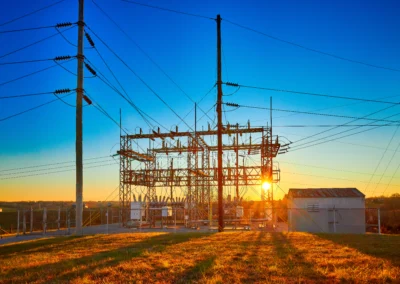
High voltage (HV) infrastructure is easy to overlook. Nobody boards a flight thinking about substations or cable runs. People expect the lights to work, the terminal to run, the systems behind it all to simply be there. But behind that expectation sits a network that has to be planned years, and in some cases decades, in advance. At Hobart Airport, that planning has been underway for some time.
The passenger terminal has effectively doubled in size over the past two to three years, part of a wave of growth playing out across the site. Beyond the public facing side of the airport are an increasing number of businesses to support the growing needs. These include food processing companies, parcel and freight distribution, additional vehicle hire facilities and many other businesses. What’s less visible, but arguably just as significant, is everything happening around it, i.e. the high voltage network being built to support the airport’s expansion for the long term.
Watch below as Jason Clark, Hobart Airport’s Electro Mechanical Controller speaks with Tom Green about the journey so far, and where it’s headed next, on site at Hobart Airport.
An Ongoing Partnership
Enginuity Power Solutions has been engaged across a number of projects at Hobart Airport, not as a single contract, but as an ongoing relationship that has grown alongside the precinct itself.
“Enginuity Power Solutions work with the Hobart International Airport, and I’d go as far as saying we partner with the airport to deliver energy strategy.”
Tom Green, Enginuity Power Solutions
That relationship has meant Enginuity Power Solutions has been present for more than one phase of the airport’s growth, working through problems as they surface and building the trust needed to plan for what comes next. This partnership has lead to Enginuity Power Solutions being announced as State Winner in the 2026 NECA Excellence Awards, recognising the project undertaken at the West Holyman Avenue precinct development.
From a Single Point of Failure to a Resilient High Voltage Network
When the work began, the airport’s distribution network had a real constraint: capacity sitting under 1 MVA, well short of what the site needed.
The bigger issue wasn’t just capacity. The precinct was originally serviced by a spur in the HV network, a single feeder line with no alternate path back to source. If a fault occurred anywhere along it, the entire area could lose power at once.
Enginuity Power Solutions addressed this directly. The team ran high voltage cable down Holyman Avenue, removed 10 poles and their overhead wires, and fully re-strung the high voltage overhead line on the airside spur. The result was a shift from a spur network to a ring-fed one, giving the site two paths back to source instead of one, and supply redundancy where there had been none.
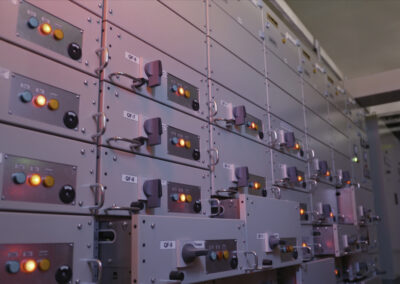
Since then, the scope has grown well beyond that first fix. Across the precinct, Enginuity Power Solutions has upgraded compliance and safety across 9 substations and 9 pole-mounted transformers, and installed or upgraded more than 6km of HV lines and underground cable.
Designing for What’s Not Yet Built
One of the more unusual challenges of working at an airport is designing infrastructure for tenants and developments that don’t yet exist.
“We don’t know at times what we’re building things for. There’s no design to say we’re putting a hotel here. There’s no design to say a rental car workshop is going to be designed here. We’re designing the infrastructure that ultimately allows for those things to happen.”
Tom Green, Enginuity Power Solutions
That’s a harder brief than it sounds. It means building capacity and flexibility into a network before the demand is confirmed, based on judgement, experience, and a close read of where the precinct is heading.
To support that, Enginuity Power Solutions has delivered a 10-year Energy Masterplan for the site, modelling future growth and reducing infrastructure risk before it becomes a problem. Alongside it, Enginuity Power Solutions partnered with Indicium Dynamics to bring the airport’s high and low voltage systems into a single platform, effectively creating a digital twin of the site’s electrical assets, a live model that reflects what’s actually happening on the ground. Instead of information scattered across disconnected systems, the airport now has a clear, centralised view of its own infrastructure, informing decisions before they’re needed rather than after.
As Tom Green puts it in a recent article on high voltage asset performance: “What we need to make sure is that the infrastructure servicing the areas is correct, is future-proofed, and ultimately is fit for purpose.”
Getting the High Voltage Forecast Right
Future-proofing isn’t only about building for growth. It’s also about not over-building. Tenants moving into a precinct will often nominate power requirements well above what they actually need, and if that number is taken at face value, it can mean spending on capacity that never gets used.
Part of Enginuity Power Solutions’ role at Hobart Airport has been helping bring those numbers back down to earth, working through realistic demand forecasts that protect the airport’s commercial position, keep spending aligned with actual need rather than speculative buildout, and managing their financial commitments without compromising on what tenants actually require.
Trust Built on the Ground
Enginuity Power Solutions has a three-pillar methodology – Consult; Design; Deliver. Hobart Airport have consistently trusted the Enginuity team across that process. Ask Jason Clark what’s made the relationship work, and the answer isn’t really about equipment.
“When you’ve got a level of workmanship that definitely for us, if we’re managing multiple contractors every day come through our counter, which we do, we could manage 30, 40, 50 jobs a day. It’s refreshing to know, and it’s always been the case, when the Enginuity staff come to the counter, we know what they’re doing and we know they’re going to do a good job and walk away and give us a service report on leaving. So we know every day that you have the tools on site, you know exactly what you’re here for and what you’re doing, and you leave it with the job done, which is refreshing.”
Jason Clark, Hobart Airport
Tom Green’s hope and response is “that trust is delivering with quality workmanship on the back end of the cycle.”
Managing multiple contractor jobs a day is not a small undertaking, and it means Hobart Airport has a clear basis for comparison. Being the crew that’s known for turning up prepared, doing the job, and reporting back before leaving isn’t a small thing either. It’s a level of trust Hobart Airport doesn’t take for granted, and one the Enginuity Power Solutions team is genuinely grateful for.
It’s also, as Tom Green notes, what makes the harder conversations possible in the first place: “Having the relationship and the avenue to have the conversation with the right people within the business, and the confidence to have those conversations, really allows for a product to be delivered.”
Trust earned on the ground is what makes the future-proofing conversations, the masterplans, the forecasting, actually work.
Continuity That Isn’t About Shortcuts
A project like this doesn’t happen in one step. It moves through consultation, design, and delivery, often over months or years, with plenty of room along the way for things to change. On this project, the same team has stayed involved throughout. That creates continuity: the knowledge and context built up at the outset carries through as the project progresses, rather than getting lost as the project moves to its next stage.
Handing a project between providers at each stage carries real risk, priorities shift, context goes missing, and the intent behind early advice doesn’t always survive the handover. Staying involved across the full journey reduces that risk substantially, and gives Hobart Airport more confidence that what was recommended early on is what actually gets built.
Part of a Wider Portfolio
Hobart Airport isn’t the only site where this approach has played out, from a high voltage upgrade at the State Library of Tasmania, to ageing infrastructure replacement at Huon Aquaculture’s Parramatta Creek facility, to an urgent cable fault response at Boral’s Bridgewater quarry.
Learn more on our approach to high voltage asset performance.
It’s worth noting that Enginuity Power Solutions is a relatively small, specialised team, not a large multinational contractor. But the Hobart Airport story shows what that size doesn’t limit: coordinating with partners, working alongside multiple contractors on-site, and holding a long-term infrastructure relationship together across years and project stages. Complex sites don’t always need a big provider. Sometimes they need the right one.
The common thread across all of it is the same: engineering-led problem solving, not just equipment replacement. It’s also part of a bigger commitment. Since 2021, that approach has helped Enginuity Power Solutions’ clients reduce carbon emissions by more than 6.5 million kg annually, while saving over $3.4 million in energy costs, a small but real contribution to the broader push toward a more sustainable future.
Ready for the Next 10 Years
Looking ahead, Jason Clark sums up what success looks like for the airport:
“Success looks like we’re ready for the next 10 years. It’s a vibrant community. This site is an amazing place to work. We’re all about connecting communities and soaring higher. So success for us in 10 years’ time would be that we’re ready for the next 10 years.”
Jason Clark, Hobart Airport
With passenger numbers forecast to grow from 2.6 million to 3.5 million by 2030, the infrastructure being built now is what makes that growth possible. It’s not glamorous work, and most people who pass through the terminal will never think about it. But it’s the reason everything else can happen.
Enginuity Power Solutions are best positioned to support large complex infrastructure projects, and the starting point is comparably simple. It all starts with a conversation. Contact Enginuity Power Solutions today.